
Gideon Training Solutions
Forged Through Discipline
Gideon Training Solutions
Forged Through Discipline
Advanced Skills
Dry-fire practice delivers the highest return on training time of any method available to a shooter. Ten focused minutes of daily dry-fire compounds into measurable skill over weeks.
The most significant improvements in shooting skill come from repetition of the fundamentals — trigger press, grip, sight alignment, and draw. Live fire provides feedback, but the mechanics of the skill are built in the mind-muscle loop that operates just as effectively without a bang.
Professional competitive shooters and law enforcement training programs all incorporate dry-fire because it allows near-unlimited repetition at zero cost per round. A shooter who dry-fires 15 minutes daily for 30 days will outperform a shooter who visits the range twice a month without dry-fire — even if the latter shoots more total rounds.
Note: check your owner's manual before dry-firing your specific firearm. Most modern centerfire handguns are safe for dry-fire. Rimfire firearms (22 LR) should use a snap cap to protect the firing pin. Some older or specialized firearms have dry-fire restrictions.
Remove all live ammunition from the room before beginning. Not just from the gun — from the room.
Inspect the firearm visually and physically to confirm it is unloaded. Then check again.
Dry-fire in a direction with a safe backstop — a brick or concrete wall, not an interior drywall partition.
Place your ammunition in a separate room or bag. Never handle ammunition and the firearm simultaneously during dry-fire.
When you are finished, before you reload, say out loud: 'Dry-fire session complete.' This creates a mental break between training mode and loaded-gun mode.
Never point the firearm at any person, pet, or object you are not willing to destroy — even during dry-fire.
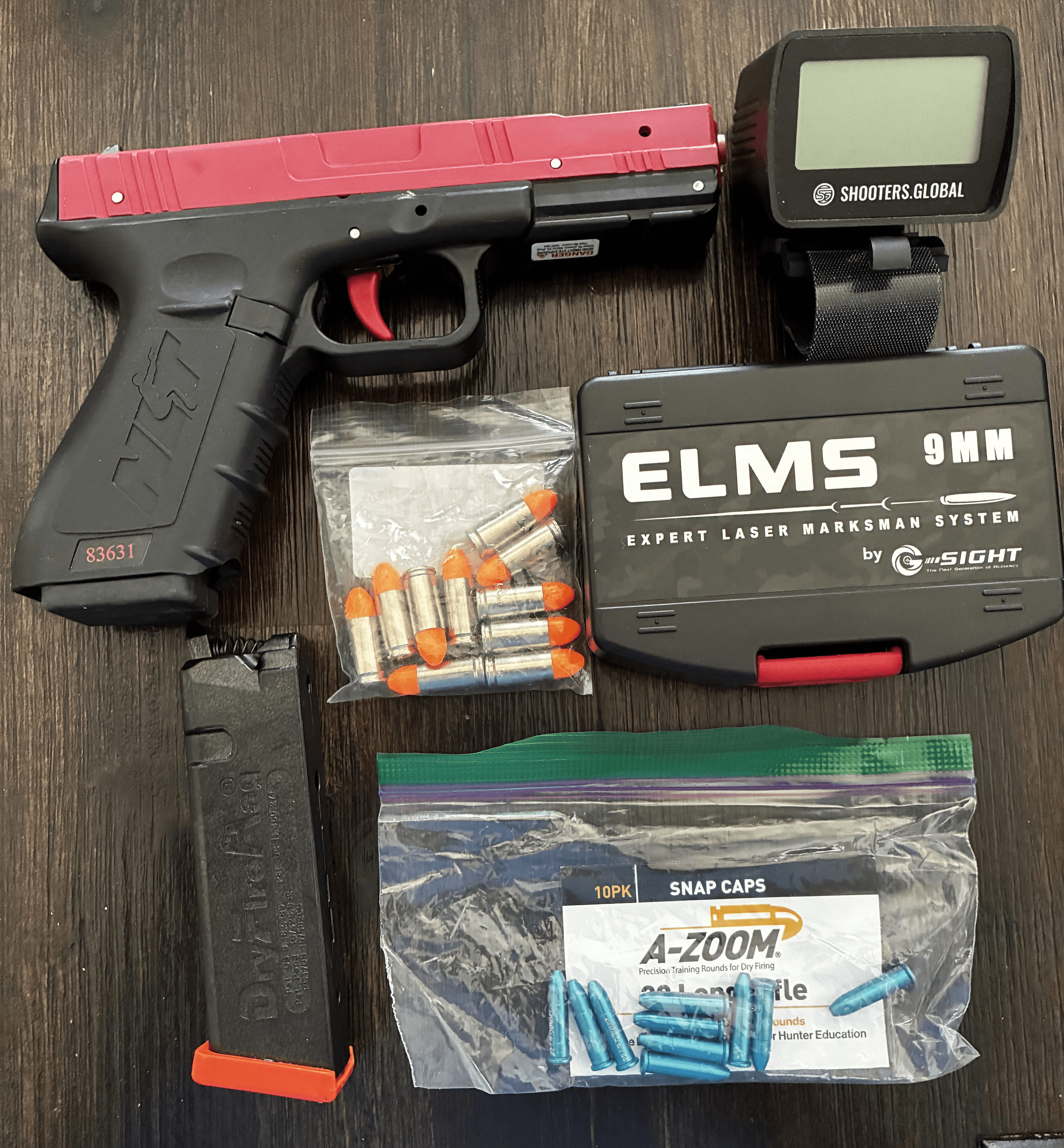
Protect firing pins on rimfire and some centerfire firearms during dry-fire. Required for .22 LR. Optional but helpful for high-volume dry-fire sessions.
Adds time pressure that forces efficiency. Use par times (a beep after a set interval) to create goal-oriented reps. Free apps exist; dedicated timers are more reliable.
Emits a laser pulse when the trigger is pressed. Used with a camera or smartphone app, these systems track exactly where the muzzle was pointed at the moment of 'fire.'
Small targets (2" circles) at close range (7 yards) force precision. Larger targets at longer distances develop sight picture. Use both. Print or buy — either works.
Stand six inches from a featureless wall. Aim at a small target (a piece of tape works perfectly). Focus entirely on trigger press — the muzzle should not move as the trigger breaks. The wall provides instant feedback if your press is disturbing the muzzle.
3 sets of 10 trigger presses
From a standing, holstered position, draw and acquire your sights on a target. Focus on a consistent grip on the draw, a smooth presentation, and front sight focus by the time the gun reaches eye level. Use a timer if available.
20 draws — slow and perfect before adding speed
Aim at your target, press the trigger, then release only far enough to feel the reset click. Press again without allowing the trigger to travel back to the starting position. This trains you to work the reset efficiently rather than fully releasing each time.
3 sets of 10 — feel the reset clearly each time
Set up two targets separated by 3–5 feet. Engage one, transition to the other, engage, return to the first. Focus on leading with your eyes (look at the next target before the gun moves) and settling the front sight before pressing.
15 transitions each direction
Practice drawing with your support hand unavailable — held at your side or behind your back. This trains you for the scenario where one hand is injured or occupied. Reholster slowly and carefully.
10 draws dominant hand, 5 support hand if your firearm allows
Consistency beats volume. Ten minutes every day produces better results than an hour once a week. Attach your dry-fire session to an existing habit — right after brushing your teeth in the morning, or before your first cup of coffee. Make the routine automatic.
Track your progress. Note which drills feel clunky and which feel smooth. The drill that feels hardest is usually the one you need most. Return to it until it feels automatic, then raise the difficulty — smaller targets, longer distance, faster par time.
Related Courses
Dry-fire builds the mechanics. Live fire validates them. Our courses put both together in a structured, instructor-led environment.
Firearms Safety & Fundamentals
Advanced Tactical Training